Cutting a Tree Down Safely

Thursday, December 13th, 2012

Cutting a Tree Down Safely Tree Removal

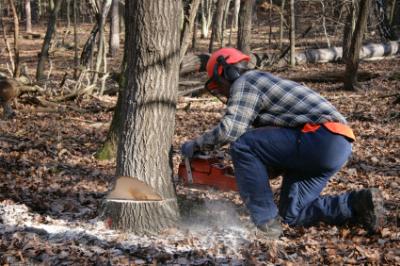
Whether a strong storm just blew through your neighborhood, or you have a dead tree in your yard that looks like it might fall down soon, it is possible to cut it down on yourself. It’s extremely important though for you to take the appropriate precautions, and to only complete such a task if you have the relevant experience.

Here’s a list of the things for cutting a tree down safely:

– eye protection
– ear protection
– working gloves
– chainsaw
– axe

How to cut down the tree:

1. Examine the area around the tree and figure out which way the tree is leaning. When you decide which direction you want the tree to fall in (it will most likely have to be in the direction the tree is leaning), be sure that area is clear and is big enough for the tree to land in without causing any other damage.

2. Clear out a couple of escape routes, either to the side or at a 45-degree angle from the direction you expect the tree to fall.

3. The first cut you will make is a wedge cut. On the side of the tree where you want it to fall, use the chainsaw to cut a notch slightly above the base of the tree. This notch should be about a third of the diameter of the tree. Next, at about a foot above the first cut, take your chainsaw and make an intersecting cut at a 45-degree angle to the tree. This should make a wedge-shaped cutout of bark. Remove this piece.

4. Go back around to the other side of the tree, opposite of the wedge cut you just made. About 2 inches above the level of your first horizontal cut, make a parallel cut on this side of the tree, and start sawing through. This should be a SLOW process, and it is critical to keep your eye on the tree.

5. Stop sawing when you are about three inches away from edge. If the tree isn’t falling, give it a small push.

You can also check out this helpful YouTube video which explains the process thoroughly.

If the job at hand is too large or too difficult to complete on your own, it may be a better idea to contact an experienced tree removal professional. Try using TalkLocal, a free service that will connect you with top-quality, reliable tree removal companies in your neighborhood, within minutes. All you need to do is enter in your problem, location, and availability and TalkLocal will contact multiple professionals, who will then call YOU directly, ready to help.


How to Clean Catalytic Converter

Thursday, December 13th, 2012

How to Clean Catalytic Converter Auto Repair

Catalytic converters

A catalytic converter is a vehicle emissions control device that converts the chemicals created by combustion in the engine into substances that are far less toxic.  The invention of the catalytic converter has mitigated the problems of acid rain and smog, but they still need to be maintained and cleaned before they become clogged.

A catalytic converter is typically used in the exhaust systems of different cars and trucks, but is used in motorcycles, airplanes, forklifts, buses, and other vehicles that are fitted with engines, as well.  A catalytic converter gets rid of hydrocarbons, carbon monoxide, and nitrogen oxide gas.  If you are worried your catalytic converter may be failing, look for signs such as stalling at high temperatures, a sulfuric smell emanating form the tailpipe, and a sluggish throttle response.

There are a few types of contaminants that can affect how your catalytic converter works, as well.  Lead can ruin your converter, as can phosphorous and silicone.  These materials can reach the catalytic converter by means of engine additives, motor oil, and engine leaks.  If your converter has been exposed to these and you are wondering how to clean the catalytic converter, don’t fret – there are ways.

How to clean catalytic converter

There are products out there that claim to clean your catalytic converter, but the ones you want to look for are ones that are long-term fixes rather than temporary fixes.  This means you will probably want to replace your catalytic converter if you have run into problems with it.  Using products simply delays the inevitable and could lead to more severe problems.

If you have read through this and believe you need to get your catalytic converter replaced, consider using TalkLocal to find you an auto repair specialist in your local area.  TalkLocal is a free service that will connect you with top-quality, auto-repair companies in your area within minutes.  Just enter in your specific problem, location and availability, and up to three companies will call you directly, saving you the time and stress of finding one yourself.


Foreign Travel Safety Tips when using Taxis

Thursday, December 13th, 2012

Foreign Travel Safety Tips when using Taxis Taxicabs

As opposed to walking or riding the subway, catching a taxi in a foreign country is usually a more efficient and safer option, especially if you don’t know where you’re going.  However, there are aspects of taking taxis that can be dangerous that you should always be aware of.  Remember to practice foreign travel safety tips when using taxis at all times to prevent any possible dangerous situations.

When traveling abroad, it is easy for the country’s locals to notice that you are a foreigner.  In this case, it is imperative to take extra precaution with your belongings and to remain aware of your surroundings. Here are some tips to take into consideration before venturing around by taxi in a foreign country:

– Only enter a taxi after locating a taxi stand.  These should be easy to find; you will see a marked sign with a long line of parked taxis.  Approach the first taxi in the line, and enter one there.  Be sure to take notice of the particular taxis as well.  If the taxi doesn’t look like others, it may be a “fake” – stay away from these.

– Be sure to know the name of the place you’re going, in the foreign language.  If possible, locate the exact address as well.

– Keep your personal belongings close and in sight.  It is very common to set down your phone or wallet on the seat next to you, and then get out of the taxi without picking it back up.  If you have heavy luggage, keep it next to you in the back seat if possible, as opposed to paying extra to use the trunk.

– Take down the taxi phone number, in case something does happen and you need to get in contact with the company.  Taxi companies often attach business cards to the back of the seats for easy acquisition.  It can also be helpful in the future if you need a taxi and aren’t close to a stand.

– If you are coming out of an airport, try to locate legitimate taxi sharing services to save on your fare.  Don’t let anyone push you into a taxi if the area is crowded, but instead try to locate an airport employee and ask about transportation services.  Try to observe what other tourists are doing to find the safest, easiest or cheapest option.

– When you do find a taxi, locate the meter immediately.  Make sure it hasn’t already started running before you even get in the car, (this is an easy way for drivers to rip you off.) If the taxi doesn’t have a meter, you’re probably better off by not getting in.

– Be sure to research the tipping procedures for your specific country.  In some countries, tipping the driver is not expected, (as fares may already be expensive enough to cover it.) In others, a 10% tip may be appropriate.

– Make sure to always have enough cash.  It’s better to over-budget a taxi ride than to under-budget and not have enough to pay for your fare.

Need help locating a taxi near you? Try using TalkLocal, a free service that will connect you to local taxi services within minutes.  Simply enter in your problem, location and availability, and TalkLocal will contact taxi companies, who will then call you directly, ready to help.

Tree Branch Uses

Wednesday, December 12th, 2012

Tree Branch Uses Tree Removal

Tree branches can fall off during a storm, when you are trimming a tree down, or when something heavy hits them.  You shouldn’t just throw these branches in the trash because there are a ton of different things you can do with them.  Tree branches are versatile and appealingly woodsy without being dirty or causing messes. Read on to learn more about tree branch uses.

Things you can make with tree branches:

– Twig Lamps/Shelves – Surround existing furniture with wood/twigs to give them a natural look.

– Bean or Pea perch – The branches will act as natural support in the garden on which beans and peas can grow.

– Rustic coasters – Cut slices of a thicker branch and finish them to use as coffee table coasters.

– Stepping stones – Use slices of the tree trunk as stepping stones in your yard.

– Coat/Key Holder – Hang a coat or keys on branches with small upward jutting extensions.

– Home décor – Plant large interesting looking branches in pots or cut unique slices and put around your house like mineral rock rounds.

– Dog Toy – Give branches to your best friend as a chew toy or fetch toy. Watch for splintered pieces.

– Vase – Hollow out the middle of thicker stumpy branches.

– Table centerpiece – Decorate a bunch of branches with ribbons and bows. Then, place them in a clear vase.

– Family tree – Attach branches to a poster board or within a frame. Attach family pictures and start labeling.

– Slingshots – Using a Y-shaped branch, attach a rubber band to the end of each split.

– Curtain holder – In place of metal rods

– Paper towel stand

– Kindling for fire

Leftover branches

If you have more tree branches than you do ideas, TalkLocal can help you find a local tree removal service.  Just enter your problem and availability onto the TalkLocal website and let them do all the work.  Within minutes you will be connected to someone who can help you out around your schedule.

Speedometer Not Working in Honda Civic

Wednesday, December 12th, 2012

Speedometer Not Working in Honda Civic Auto Repair

Your speedometer is an important part of your car.  It helps you to gauge how fast you are traveling.  It also helps you understand how long it will take you get to your destination, as well as helps you stay within the speed limit. Read on for some helpful suggestions if the speedometer is not working in your Honda Civic.

Potential problems

–  Variable speed sensor

–  Exhaust gas recirculation system

–  Wire pack at rear of engine

Variable speed sensor

One thing that could be causing your speedometer to malfunction is the variable speed sensor unit.  Located on the transmission, it could stop working because the connection to display the speed is corroded.  You should replace the wire that connects the sensor to the display.  The VSS is the direct communicator between the speedometer and the speed, so this is usually what will cause the display malfunction.

Exhaust gas recirculation system

Another potential issue could be with the exhaust gas recirculation system.  If it is turned on when your vehicle goes over 10 miles per hours, it could be the cause of your speedometer display issues.  It could lead to an incomplete combustion that fries your cars ability to show how fast you are going.

Wire pack at rear of engine

If neither of these seem to be the issue, you should check under your hood.  Near the rear of the engine is a pack of wires.  They sometimes rub on the bottom against a piece of metal and this creates a short circuit.  This will screw up the speedometer as well as turn on the check engine light.  You simply need to crawl under the car and gently turn this pack of wires over and tape them up so that they will stop shorting out.

Continuing problems

If you continue to have problems with the speedometer in your Honda Civic malfunctioning, you should seek professional help.  Use TalkLocal to be put in contact with reliable local businesses almost immediately.  Simply input your problem, location and availability, and TalkLocal will do the rest.  Within minutes, you should be connected to a qualified auto repair professional who is willing to help.

What are the Different Types of Limos?

Wednesday, December 12th, 2012

What are the Different Types of Limos? Limo Rental

The term limousine refers to a luxury vehicle, generally longer than an average car, that is driven by a chauffeur.  Limousines are conventionally black or white, yet there is also a plethora of custom made limousines by various companies that can range in color, shape and amenities that may even include hot tubs or jacuzzis.  Limousines are by far the most expensive form of transportation and give off an image of wealth and/or power.  In addition to the wealthy users of limousines, people treat themselves to limousine transportation for special events such as weddings, proms and other extravagant parties. Politicians and other high ranked government officials are also frequent limousine users. What are the different types of limos?  Read on for more information.

Sedan limousine 

There are many different types of limousines that vary in size and other features.  The smallest limousine is the sedan limousine.  This limo is generally the cheapest to rent as it only fits 2-3 individuals comfortably.  This limo is generally most commonly rented for airport travel.  This type of limousine can also be used as an alternate to a taxi cab.  The most common sedan limousine is a Lincoln Towncar and is generally black.

Stretch limousine

Stretch limousines are similar to sedan limousines, expect they are longer.  There are three types of stretch limos that vary in size.  There is a six-pack, eight-pack and a ten-pack.  The stretch limousine is a good option for a smaller gathering.  Be aware, though, that even though a limousine may claim to fit 10 people comfortably, it may be a little uncomfortable and cramped.

Super stretch limousine

There are also super stretch limousines.  Super stretch limousines come in many different models such as Towncars and Bentleys, and they even come in SUV’s such as Excursions, Escalades, Hummers and more.  Super stretch limousines are a great option for parties where everyone wants to travel together.  These limos fit anywhere from 14-20 people comfortably.  Some models even include a fifth door for easier entrance/exit for the passengers.  There are many amenities included inside such as televisions, bars and exotic lighting.  Make sure you have a professional and licensed driver that you can trust because driving a lengthy vehicle is difficult to drive and turn.  Super stretch limousines are the most popular option and surprisingly one of the most popular colors are pink.

Party bus

Party buses have been rising in popularity recently.  Party buses provide the same luxuries as other limousines, yet they are large enough to comfortably stand up, walk around and stretch your bodies out.  These buses are ideal for partying on the go as many buses have dance poles in addition to lighting that is reminiscent of a club.  Party buses are the best option for fitting the most passengers as they can fit up to 44 people.

The price difference between a sedan limousine and stretch limousine are minimal, thus when booking a limousine for the airport or a business trip ride in a stretch limousine for an additional small fee.  If you are looking for a good limo service for an upcoming event, use TalkLocal.  This completely free service will connect you to up to three highly rated limousine companies in your area within minutes.

When Should I Fertilize my Lawn

Monday, December 10th, 2012

When should I fertilize my lawn Landscapers

Fertilizing your lawn is an important step to maintaining a good-looking lawn. A lawn needs food just like any other plant, and fertilizer is the only way to feed it. A properly fertilized lawn is healthier, meaning it can battle through severe weather conditions more effectively. You may be asking yourself, “When should I fertilize my lawn?” Feeding your lawn even once a year can improve its condition, but feeding it four times a year is even better. Putting your lawn through a schedule like this can make your lawn look lush and green.

First Round

Early Spring (February thru April) is the first time during the year where you will want to fertilize your lawn. During this period, food is of the utmost importance if you want to have a lush lawn during the year. Feeding your lawn in the spring strengthens the roots and gives it the food it needs to grow.

Second Round

The next period where you will want to feed your lawn is in late spring, from April to June. During this time, your lawn is using up its stored energy and needs more to continue its growth. However, this is also around the time where weeds begin to sprout, so you will want to get rid of these to continue your lawn’s growth.

Third Round

The summer months of June through August are the next stage of the feeding schedule. These summer months are important because heat, drought, insects, and storm damage can all take their toll on a lawn. Feeding your lawn during this period helps to strengthen the lawn and protect against these problems.

Fourth Round

The fall months of September through November comprise the last timeframe for fertilization of your lawn. These months generally have cool nights, plenty of rainfall, and morning dew — basically as good as it gets for lawns. Apply the final feeding before the winter months and the cold kick in. This will allow for a healthier and greener lawn the following spring.

Professional Help

Following a plan like this will allow you to keep your lawn lush and green and capable of handling any problems that may test the strength of your lawn. If you would prefer professional help, consider using TalkLocal to find a landscaping specialist for you. TalkLocal is a free service that will connect you with top-quality, landscaping companies in your neighborhood within minutes. Just enter in your specific problem, location, and availability, and up to three companies will call YOU directly — saving you the time and stress of finding one yourself.

Get Rid of Carpenter Ants in the House

Monday, December 10th, 2012

Get Rid of Carpenter Ants in the House Pest Control

Carpenter ants are some of the most aggressive wood destroyers found in nature, but it’s incredibly important to know that carpenter ants don’t eat wood for food. Rather, they simply tunnel through wood to enlarge their nest — but this excavation can be extremely costly and expensive to homeowners. In order to get rid of carpenter ants, you should only use bait or non-repellent insecticides. Read on to learn more about how to get rid of carpenter ants in the house.

Don’t spray without thinking

Simply spraying exposed ants without thinking about the consequences may actually exacerbate the problem. Many chemical repellents and insecticides will force the ants to simply avoid the sprays. If you find the nest and spray close to the nest, the queen may actually split the colony into multiple satellite nests, making ant control very difficult.

You also want to make sure that your problem is actually carpenter ants, rather than termites. You can find this out by checking the frass, or small piles of excavation material. These small piles should have dead ant material and small wood chips and should not be confused with sawdust or drywood termite fecal pellets.

Baiting the ants

Bait is one of the most effective carpenter ant solutions. You should apply these baits in small quantities (like a teaspoon) near the nest and then check it periodically to see whether or not the ants are still eating it. As long as the ants keep on taking it, keep on replacing the bait since the colony may have thousands of ants.

Alternatives to bait

You can also use non-repellent spray insecticides or dusts. The ants will crawl through the dust or spray without realizing it and eventually, within a week or two, die off.  It’s imperative that these alternatives are non-repellent so that the carpenter ants aren’t forced to begin satellite colonies.

Ultimately, if you have a significant problem with carpenter ants, you should professional pest control company to get rid of your carpenter ant problem. TalkLocal can connect you with a high quality local pest control expert in just minutes, so you can have this ant problem wrapped up as soon as possible.

How to Kill a Tree without Cutting it Down

Monday, December 10th, 2012

How to Kill a Tree without Cutting it Down Tree Removal

Trees are part of landscaping that can beautify a lawn or community.  A tree-lined avenue can truly improve the look of a road.  However, these trees can overgrow or become damaged, resulting in a negative appearance for the neighborhood. Luckily, there is a way to deal with this problem. Below are tips for how to kill a tree without cutting it down.

Some people find themselves between a rock and a hard place with their neighborhood trees.  They want to get rid of certain trees, but they don’t want to pay for the process of getting it cut down. By killing it first they can get around the financial burden because the city will remove any dead trees for free.

There are a couple different options for people to pursue to kill trees without cutting them down.  The easiest is to cut a thick ring around the bark at the base of the tree trunk.  You can chip the bark off in a wide circle to be extra sure that this will work.  This process works because it exposes the inner tree to the elements and to disease.  It also scars the trunk so that it cannot absorb nutrients properly and then the tree begins to die from lack of sustenance.

You can also try to pour gasoline around the base of the tree so that the roots will absorb it.  This toxic substance will also speed the killing process.  If you want to move on to another option you can drill holes into the trunk of the tree.  Remove the bark where you want to drill and using a power drill and biggest drill bit to take out a deep hole from the base.  Fill this area with a mixture of diesel and roundup for the tree to absorb.  Superglue the bark back into place to hold everything in.  Repeat this process around the entire base and this should kill the tree within six months.

Continuing Problems

If you have more questions about what you can do to kill a tree without cutting it down, you should try to talk to a professional so that you can get the best help possible.  The easiest fastest way to get in contact with reliable local landscaping service businesses is to use TalkLocal. Just put in your problem and availability and let them do all the work.  Within minutes you will be connected to someone who should be able to help you out.

Measuring Blinds for Bay Windows

Monday, December 10th, 2012

Measuring Blinds for Bay Windows Window Replacement

Measuring blinds for bay windows is fairly easy and can be done at home.  There are many types of bay windows including Roman bay windows and vertical bay windows.  The following steps cover how to properly install and measure your blinds for bay windows.

Measuring blinds for bay windows:

1.  Pick out your blinds of choice

2.  Place the blinds in the left, center and right panels.  The intersection points of the blinds should be your key focus when measuring.

3.  Notice the points of intersection and measure how long the left panel must be to properly fit in place from the intersection point marked A to the opposite end of the left panel (the window frame).  This is the length of the left blind.

4.  Measure the far end of the right blind (the window frame) to the intersection point marked B.  This is the length of the right panel.

5.  The length of the center panel is the measurement between intersection points A and B.

6.  When taking into account the brackets, add 2 inches to the height.

7.  Place the outside mounts directly outside the window frame.

Because there will inevitably be a gap due to the nature of the angles of bay windows, it is best to have a professional install the windows.  This will reduce the amount of gapping and the amount of light leaking into the room.  Use TalkLocal to be connected for free to a professional in your area within minutes.